






Deep Learning for Cervical Cancer Detection using Pap Smear Images
Panamerican Mathematical Journal
Advanced deep learning techniques for automated cervical cancer screening using convolutional neural networks.
📊 Citations: 12📈 Impact Factor: 2.1
2024
Machine Learning Approaches for Diabetes Risk Prediction
Frontiers in Health Informatics
Comprehensive analysis of ML algorithms for early diabetes detection using clinical parameters.
📊 Citations: 8📈 Impact Factor: 1.8
2024
Enhanced Word Sense Disambiguation using Context-Aware Neural Networks
Copyrighted Research Work
Novel approach to natural language processing using transformer-based architectures for semantic understanding.
🔬 Status: Under Review
2024
Autonomous Drone Navigation Console
Patent Application
Innovative control system for autonomous drone navigation with real-time obstacle avoidance capabilities.
📋 Patent ID: IN202410...⚖️ Status: Filed
📝 Blog / Articles
Aug 2025
Mastering C Programming: A Comprehensive Guide for Engineering Students
C programming remains the cornerstone of computer science education. This guide explores fundamental concepts, best practices, and practical applications that every engineering student should master.
Why C Programming Matters
C programming language, developed by Dennis Ritchie in 1972, continues to be relevant in modern software development. Its efficiency, portability, and close-to-hardware nature make it essential for system programming, embedded systems, and performance-critical applications.
Core Concepts Every Student Must Know
1. Memory Management: Understanding pointers, dynamic allocation, and memory leaks prevention is crucial. Always pair malloc() with free() to avoid memory leaks.
2. Data Structures: Arrays, linked lists, stacks, and queues form the foundation. Practice implementing these from scratch to understand memory layout and pointer manipulation.
3. Function Design: Write modular, reusable functions. Follow single responsibility principle - each function should perform one specific task.
Best Practices for Clean Code
Use meaningful variable names (studentCount instead of sc)
Comment complex algorithms and business logic
Validate input parameters in functions
Handle error conditions gracefully
Use const keyword for read-only parameters
Conclusion: C programming builds strong foundational skills that translate to other languages. Practice regularly, write clean code, and always prioritize readability and maintainability.
Aug 2025
Deep Learning Fundamentals: From Neural Networks to Real-World Applications
Deep learning has revolutionized artificial intelligence. This comprehensive guide covers neural network fundamentals, key architectures, and practical implementation strategies for beginners and intermediate learners.
Understanding Neural Networks
Neural networks are computational models inspired by biological neural systems. They consist of interconnected nodes (neurons) organized in layers that process information through weighted connections and activation functions.
Core Components Explained
1. Neurons and Layers: Input layer receives data, hidden layers process information, and output layer produces results. Each neuron applies weights, adds bias, and uses activation functions.
2. Activation Functions: ReLU (Rectified Linear Unit) is most common for hidden layers due to computational efficiency. Sigmoid and Tanh are used for specific scenarios. Softmax is ideal for multi-class classification output.
Future Outlook: Deep learning continues evolving with attention mechanisms, self-supervised learning, and neural architecture search. Stay updated with latest research and practical applications in your domain.
Aug 2025
AI/Machine Learning Tutorial: Building Your First Intelligent System
Step-by-step guide to understanding and implementing machine learning algorithms. Learn practical AI development from data preprocessing to model deployment.
Introduction to Machine Learning
Machine Learning is a subset of artificial intelligence that enables computers to learn and make decisions from data without explicit programming. This tutorial covers essential concepts and practical implementation strategies.
Types of Machine Learning
Supervised Learning: Uses labeled data to train models. Examples include classification (email spam detection) and regression (price prediction).
Unsupervised Learning: Finds patterns in unlabeled data. Clustering customers by behavior or dimensionality reduction for data visualization.
Reinforcement Learning: Learns through interaction with environment. Used in game playing, robotics, and autonomous systems.
Next Steps: Practice with real datasets from Kaggle, experiment with different algorithms, and build end-to-end projects to solidify your understanding.
Jan 2026
General Problem Solving Concepts: A Systematic Approach to Complex Challenges
Master the art of problem-solving with systematic approaches, analytical thinking, and proven methodologies. Essential skills for programming, engineering, and life challenges.
Understanding Problem Solving
Problem solving is a systematic process of identifying, analyzing, and resolving challenges. It's the foundation of programming, engineering, and critical thinking across all disciplines.
The Problem-Solving Framework
1. Problem Identification: Clearly define what needs to be solved. Ask "What exactly is the problem?" and "What are the constraints?"
2. Analysis & Understanding: Break down complex problems into smaller, manageable components. Identify inputs, outputs, and relationships.
3. Strategy Development: Choose appropriate problem-solving techniques - divide and conquer, pattern recognition, or algorithmic thinking.
4. Implementation: Execute your solution systematically, testing each component as you build.
5. Evaluation & Refinement: Test your solution thoroughly, identify edge cases, and optimize for efficiency.
Key Problem-Solving Techniques
Divide and Conquer: Break large problems into smaller sub-problems. Solve each part independently, then combine solutions.
Pattern Recognition: Look for similarities with previously solved problems. Adapt existing solutions to new contexts.
Abstraction: Focus on essential features while ignoring irrelevant details. Create models that capture the problem's core.
Algorithmic Thinking: Design step-by-step procedures that can be followed systematically to reach a solution.
Problem-Solving in Programming
Pseudocode First: Write solution logic in plain language before coding. This helps clarify thinking and identify potential issues.
Test-Driven Approach: Define expected outcomes before implementation. Create test cases that validate your solution works correctly.
Iterative Refinement: Start with a basic working solution, then optimize for performance, readability, and maintainability.
Common Problem-Solving Pitfalls
Jumping to Solutions: Resist the urge to code immediately. Spend time understanding the problem first.
Overcomplicating: Simple solutions are often better. Don't add unnecessary complexity.
Not Testing Thoroughly: Test with various inputs, including extreme cases and invalid data.
Developing Problem-Solving Skills
Practice Regularly: Solve coding challenges on platforms like LeetCode, HackerRank, or CodeChef. Start with easy problems and gradually increase difficulty.
Learn from Others: Study different solution approaches. Understand why certain methods are more efficient or elegant.
Document Your Process: Keep notes on problem-solving strategies that work well. Build your personal toolkit of techniques.
Real-World Applications
Software Development: Debugging code, optimizing algorithms, designing system architecture.
Research: Formulating hypotheses, designing experiments, analyzing data patterns.
Conclusion: Problem-solving is a learnable skill that improves with practice. Master these fundamental concepts, and you'll approach any challenge with confidence and systematic thinking. Remember: every expert was once a beginner who never gave up.
Jan 2026
Basics of Python Programming: Your Gateway to Modern Development
Learn Python fundamentals with practical examples. Master syntax, data structures, functions, and object-oriented programming concepts essential for modern software development.
Why Python?
Python is beginner-friendly, versatile, and widely used in web development, data science, AI, automation, and more. Its clean syntax makes it perfect for learning programming concepts.
Getting Started
Installation: Download Python from python.org or use online editors like Repl.it or Google Colab for immediate practice.
Your First Program:
print("Hello, World!")
name = input("Enter your name: ")
print(f"Welcome to Python, {name}!")
Core Data Types
Numbers: Integers (42), floats (3.14), and complex numbers (2+3j)
Strings: Text data enclosed in quotes. Support slicing, formatting, and many built-in methods.
Booleans: True/False values for logical operations and conditions.
# Examples
age = 25
name = "Python"
is_student = True
print(type(age)) #
Data Structures
Lists: Ordered, mutable collections. Perfect for storing sequences of items.
fruits = ["apple", "banana", "orange"]
fruits.append("grape")
print(fruits[0]) # apple
Dictionaries: Key-value pairs for structured data storage.
Use meaningful variable names (student_count, not sc)
Follow PEP 8 style guide for consistent formatting
Write docstrings for functions and classes
Handle exceptions with try-except blocks
Use virtual environments for project dependencies
Next Steps: Practice with small projects like calculators, to-do lists, or simple games. Explore Python's vast ecosystem and find your area of interest - web development, data science, or automation.
Aug 2025
Software Development Best Practices: Writing Maintainable and Scalable Code
Essential practices for professional software development. Learn coding standards, design patterns, testing strategies, and collaboration techniques used in industry.
Clean Code Principles
Clean code is readable, maintainable, and self-documenting. It reduces technical debt and improves team productivity.
Naming Conventions
Meaningful Names: Use descriptive variable and function names. Prefer 'calculateTotalPrice()' over 'calc()' or 'process()'.
Consistency: Follow established naming patterns throughout the project. Use camelCase or snake_case consistently.
Function Design Best Practices
Single Responsibility: Each function should do one thing well. Keep functions under 20-30 lines when possible.
Continuous Improvement: Regularly refactor code, update dependencies, and adopt new best practices. Software development is an evolving field requiring continuous learning.
Teaching
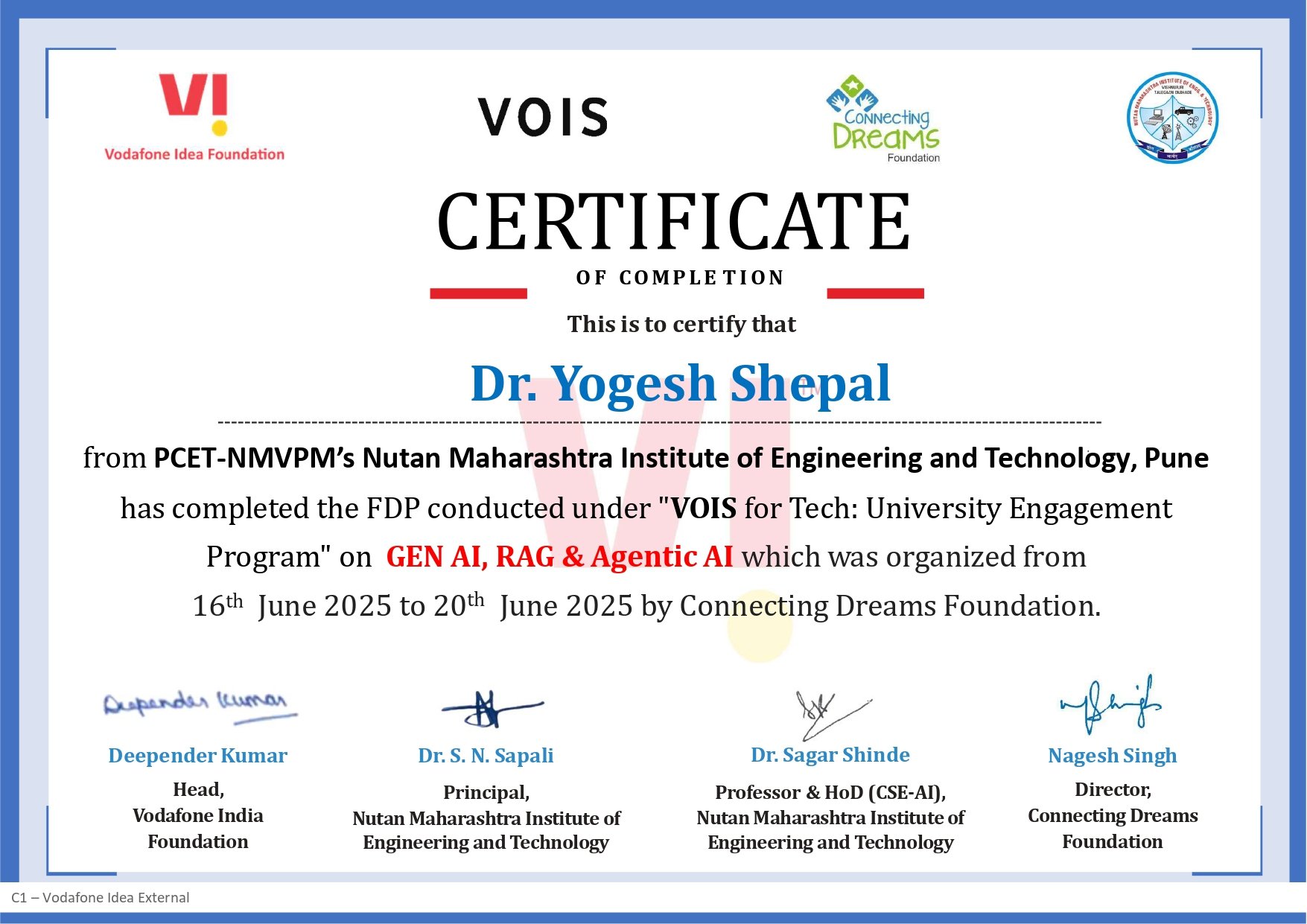
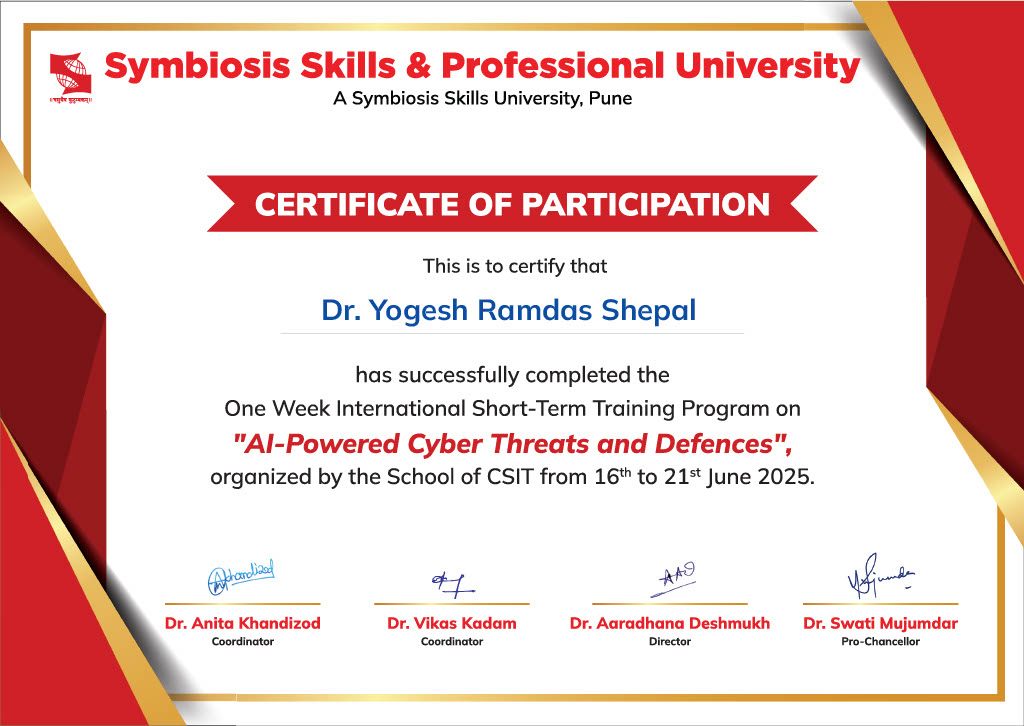
I have taught at multiple institutes including ASM NEXTGEN, PCET NMIET, Sinhgad Institute, PRES and D.Y. Patil College.
My areas include C, Java, and AI.